|
Infrastruktura - Środowisko - Energia
Dodatek lobbingowy do "RZECZPOSPOLITEJ".
20 listopada 2007 r.
po polsku
Selected aspects of performance of a gas distribution system operator
Kazimierz Nowak, President of the Management Board of Mazowiecki Operator Systemu Dystrybucyjnego Sp. z o.o. (Mazovian Distribution System Operator) and ProLinea Towarzystwo Rozwoju Infrastruktury (ProLinea Infrastructure Development Association)
 On 1 July 2007, as a part of process aimed at meeting the provisions of the Directive 2003/55/WE (New Gas Directive) and implementing the amended Energy Statute in Poland, the Mazowiecka Spółka Gazownictwa Sp. z o.o. (Mazovian Gas Company, MGC) was transformed into the Mazovian Distribution System Operator (MDSO). On 1 July 2007, as a part of process aimed at meeting the provisions of the Directive 2003/55/WE (New Gas Directive) and implementing the amended Energy Statute in Poland, the Mazowiecka Spółka Gazownictwa Sp. z o.o. (Mazovian Gas Company, MGC) was transformed into the Mazovian Distribution System Operator (MDSO).
The MDSO is one of the six distribution system operators who form the Polish Oil and Gas Company (PGNiG S.A.) and who have continued operator activities subce gas trading was separated from gas companies in the program of consolidation of gas trading. The basic activity of the company is to provide gas fuel distribution services and to assure safe and uninterrupted performance of the distribution system under its management. The company's operation covers six provinces, i.e. Mazowieckie, Łódzkie, Podlaskie, and a part of Warmińsko - Mazurskie, Lubelskie, and Świętokrzyskie. Currently the company manages 390 kilometers of high pressure pipeline and 23.5 thousand kilometers of medium and low pressure pipelines and terminal lines, and it distributes approximately 1.7 billion cubic meters of natural gas to nearly 1.5 million customers.
Immediately after its formation, the MDSO needed to develop a comprehensive strategy, from determining the organization model and the mode of operation, through arranging ownership relations, to elaborating a comprehensive concept of managing and developing its distribution network. This strategy will have to focus on the growing competitive pressure, especially on the part of smaller companies who provide operator services and sell gas fuel at the same time. These small companies will most likely be more flexible in their services because of their broader scope and the resulting diversification of their revenue sources.
Organization of the MDSO
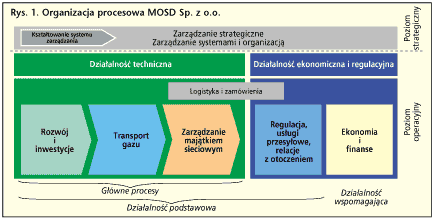
Preparations in the company to take the role of a gas distribution system operator started in early 2004, before the MGC was transformed into the MDSO, as required by the New Gas Directive. The work was based on the assumption that as the new organization is preparing for its role as an operator, it should also adjust to the new and changing conditions of the gas sector in Poland, by using specific "good practices" in both its internal and external operations, and by taking advantage of the knowledge, experience, and econometric tools provided by an outside advisor. Thus, in three years, a new organization based on identified main business processes to be performed by a distribution system operator (graph no. 1), was built nearly from scratch. As a result of these changes, on 1 April 2007, still within MGC, a new regional division of distribution services was implemented and the 3 Gas Plant Divisions and 5 Gas Distribution Districts that had existed before were replaced with the 6 Gas Facilities Divisions located in Białystok, Ciechanów, Mińsk Mazowiecki, Łódź, Radom, and Warsaw. The changes also involved replacing the five-level organizational management model with a three-level model.
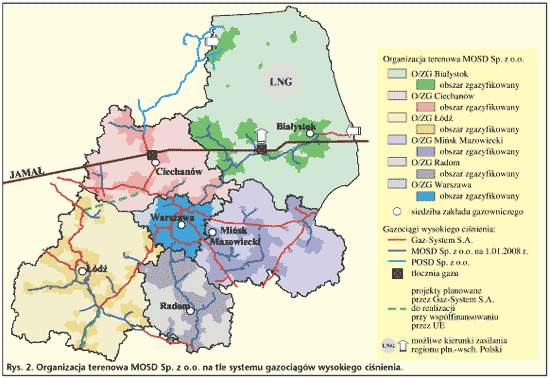
In hindsight, we can say that the decision to start early preparations to design the organization of the operator company, despite the lack of solid information on the possible ownership changes, was a good decision, as it allowed the company to create an optimum organization and facilitated the transformation from operator structures integrated with gas trading structures to strictly operator structures. We understand that the model of the company's operation and its organizational structure cannot be considered as final and that we should still strive to improve it. As an example, the organization needs to be adjusted due to the planned takeover by the MDSO of approximately 150 high pressure gas stations that have been excluded from the leasing agreement between the PGNiG and the Gaz-System S.A company (graph no. 2).
As a natural gas distribution system operator company, the MDSO makes every effort to provide the highest standard of customer service. Currently the company is undergoing certification of our Quality Management System in accordance with the ISO standard. Also, in order to maintain high quality standards, we are implementing the Environmental and Occupational Health and Safety Management System.
The legal circumstances of the company's performance and development
The key legal documents that regulate the work of a distribution system operator and the development of a gas distribution system include:
-
New Gas Directive 2003/55/WE,
- Statute on energy of 10 April 1997 (with subsequent changes),
- Statute of 27 March 2003 on spacial planning and arrangement (with subsequent changes),
- Statue on construction of 7 July 1994 (with subsequent changes),
- Statue on real estate management of 21 August 1997 (with subsequent changes),
- Statue on environmental protection of 27 April 2001 (with subsequent changes) and Statute on preservation of nature of 16 April 2004 (with subsequent changes),
- Ordinance of the Minister of Economy, Labor, and Social Policy of 6 April 2004 on detailed conditions for connecting entities to gas networks and on operation and utilization of such networks,
- Ordinance of the Minister of Economy, Labor, and Social Policy of 15 December 2004 on detailed principles of determination and calculation of fares and accounting in gas fuel trading,
- Ordinance of the Minister of Economy of 30 July 2001 on technical conditions to be met by gas networks.
The above legal documents frequently slow down the pace of growth and the time of completion of line projects, mostly due to their inconsistency. The biggest obstacles in planning and performing network projects are the long procedures to coordinate and approve the required documentation and to obtain administrative decisions. It is necessary to quickly start a discussion on changing some legal documents in order to work out a legal model that eliminates the obstacles that currently hinder performance of projects. There is a need for changes in statutes directly related to operator's performance and especially for preparation of the legal framework in statutes and other basic legal acts in areas that include:
-
spatial planning and arrangement,
- environmental protection to include preservation of nature,
- construction law,
- real estate management
such changes will facilitate the performance of line projects, and in particular the process of determining the location of projects and of acquiring land for such projects.
Creation of adequate conditions for planning and performance of line projects requires cooperation between investors and representatives of both the national and the local government. The Ministry of Regional Development has been working, since 2006, on the new Concept of National Spacial Arrangement for the years 2008 - 2033 (CNSA). The goal of the CNSA is to create a framework for spacial planning and arrangement documents elaborated on any level of local government, to include the definition of specific elements of spacial structure such as location of technical infrastructure facilities. Moreover, the CNSA formulates guidances concerning the institutional settings of the spacial management and suggestions concerning changes in the legal system that determines spatial planning and arrangement. Successful completion of the MDSO's interregional projects will depend, among others, on whether such project will be included in CNSA's consultations with the government administration in provinces. From the MDSO's point of view, the most urgent taks is to actively participate in the process of developing spacial arrangement plans on the local government level.
Concerning the growth plans of the MDSO, especially in the north-eastern parts of Poland that have the lowest rate of gas supply availability, one should remember the Statute of 16 April 2004 on preservation of nature, which creates the so-called Nature 2000 network as a new and separate form of preservation of nature. The necessity to consider these areas in project planning may translate not only into a significant increase of cost, but also into the lengthening of the process of preparation and performance of network projects, and in extreme cases it may result in a changed course or even in abandonment of a concept of building gas pipelines to supply gas to customers.
What is very important from the point of view of assuring adequate financing of the company is proper calculation of the prices of distribution services which include not only the operator's cost but also a return on its own capital. Due to the fact that the company's operations are regulated by law and that its fares are subject to approval by the Energy Regulatory Office, the MDSO is not free to set prices of distribution services, which affects its financial and economic situation, and in particular the profitability of its licensed activities, which in turn determines the availability of funds required to finance new capital projects.
The Statute of 28 July 2005 on public-private partnership is very important to the performance of line projects as it allows public entities, including local governments, to acquire from private investors the funds to cover their own share of cost of projects to be co-financed by the EU, which is particularly important in commercial projects which will become stable sources of revenue.
Technical conditions for enlarging the distribution system
In order to increase its revenue, the distribution system operator should increase the number of active recipients of gas. Besides encouraging those recipients who are already connected to the network, but do not utilize gas, to consume the natural gas supplied through the network, the most effective method to increase the number of active recipients is to conduct actions to activate the customer base in areas with spare transfer capacity and to connect additional recipients who do not require any reconstruction of the existing network.
What may turn out to be a real challenge is the expansion of the existing network and laying new pipelines in new areas. Expansion of the network into areas without existing pipelines is ofter limited by external factors. The most important include the lack of capacity to supply gas in potential gas supply infrastructure and connections projects, which becomes a key factor in determining possible areas of development for the distribution system operator. For example, gas infrastructure projects in north - eastern Poland are severely limited by the lack of spare transfer capacity in pipelines belonging to the Pomeranian Dystribution System Operator, which supply gas in the area of the Great Mazurian Lakes, and a similar lack of spare transfer capacity in the Bobrowniki - Białystok - Rembelszczyzna pipeline, which supplies natural gas to that region and is currently operated by the Gaz-System S.A. company.
A significant improvement in the area of development of the gas supply and of the distribution system in that region could occur in the case of acquiring other sources of supply, such as the Yamal Pipeline, modernizing the pipeline between Poland and Belarus, the so-called Tietierovka, or delivery of liquefied natural gas (LNG) into a gas terminal by the means of land transportation (graph no. 2).
Assuring additional sources of supply most often requires large investment outlays, especially that such projects should take into account potential further expansion of the distribution system and the resulting increase in the demand for gas fuel. In a situation where none of the players in the market wants to take the risk of an investment that is not optimized, the decision-making process to start an expansion of the system is often difficult and time-consuming. The development of adequate sources of supply can only be assured by a partner-like, close, and responsible cooperation between the operators of the distribution and transfer system, the suppliers of gas, the local administration, and the final customers. Such cooperation should assure fair sharing of both potential profits and risk between all the participants in this process.
While discussing the technical conditions of the MDSO's operation, it is worth mentioning the "island" character of the distribution system, which is a result of the split of the system into the transfer part and the distribution part that has been made during the reorganization of the sector, and of the insufficient demand for natural gas that has been in place for many years and the consequent the lack of projects to expand the gas supply. Consequently, the company may frequently be forced to cancel smaller projects aimed at expanding the supply and connecting new customers and even to refuse to connect customers who are very attractive with respect to their potential usage and to their gas intake characteristics. Using the LNG technology may be a solution to the "island" nature of the distribution system and the resulting lack of supply sources. However, in this case, an individual approach to each project will be necessary in order to account for the varying legal, technical, and logistical circumstances of such projects.
Progress in the expansion of the distribution system under the company's management and in building new supply sources will facilitate connecting new customers to the gas network, which will in turn result in fewer instances of abandonment of supply and connection projects and thus increase the benefits to both the customers and the operator.
Market conditions of expansion of the distribution system
What is an equally important factor in making development decisions is the existence of a market for the distribution service that the company provides, that is of adequate demand for gas fuel. In deciding to build another section of the distribution network, the operator must have a minimum of certainty that the revenue generated as a result of this project will bring a return, in a reasonable amount of time, of the expenditures, and suffice to cover the cost of maintenance and safe operation, which are fixed costs independent of the rate of utilization of the pipeline. Due to this concern, the supply and connection projects do not always meet the expectations of potential customers, the trading companies (who do not bear the risk of long-term involvement in the construction and maintenance of the network), the national and local government, and the local communities who sometimes expect that the operator company, who works in accordance with the principles of the free market, should fulfill its mission to supply gas, and thus improve the standard of living, without any economic justification. What may be a solution to the problem of meeting the expectations of the market is the formula of consulting the development and modernization projects for the next several years. This would serve the purpose of verifying the assumptions concerning the existing and planned demand for natural gas. Such consultations could take the shape, on the part of the distribution system operator, of a publicly presented and available multi-year (for example 10-year) Development plan. Such plan could take the shape of an incremental, optional document that presents various options of development in the market for gas and the expansion of the supply infrastructure in the context of continuously updated economic analyses. Such a plan would inform the customers of potential expansion of the network and assist them in long term planning of natural gas supply. For the distribution system operator it would constitute a basis for formulating even more reliable development plans (in accordance with the provisions of the statute on energy) and for long-term financial planning of its operations.
The local government administration plays an essential role in the context of the issue of expansion of the distribution network. On the one hand, together the energy consumers, the local government administration is the main factor affecting demand for gas and for expansion of the network. On a regional scale, through its regional policies, it determines the position of the operator and of gas fuel on the energy map and in infrastructural plans. The laws that are currently in force and that regulate these issues explicitly limit the influence of the operator on the spacial and energy planning, without requiring the local government authorities to consult their plans with the gas company (the operator or the gas trading company) and only giving the latter the right to present its remarks in the process of social consultations. Consequently, if the operator (in cooperation with the gas trading company) does not include the locally planned facilities in its investment plans, the need to expand the natural gas distribution network may even go unnoticed. On the other hand, good cooperation with local government entities allows for a much more effective process of preparation and performance of expansion, modernization, and connection projects. Improving relations with local authorities, especially in the area of expansion of the distribution network, was one of the key reasons for organizational changes in the MDSO, namely the consolidation of the Gas Distribution Districts (formerly the Gas Distribution Plants), the creation of the 6 Gas Utility Divisions, and granting more authority in this respect to the managers of those units.
Absorption of European Union funds
One of the outcomes of Poland's accession to the European Union, besides the need to implement the Union's laws on liberalization of the energy market, was the inclusion of Polish enterprises in the European structural policies. Companies in the gas sector can also apply for funding in the the 2007 - 2013 budget period. The list of key projects of the 10th Priority Axis of Operational Programme Infrastructure And Environment (OPIE) includes investment project of the PGNiG and the Gaz-System companies. The PGNiG will receive financing for, among others, the construction of the LNG terminal on the Polish Baltic coast, and for the construction and expansion of underground gas storage reservoirs, while the Gaz-System company is planning to use the EU funds to build and modernize those sections of the transfer network that are strategic from the standpoint of energy security. The following three projects are essential to the availability of fas fuel sources in the MDSO's area of operation:
-
KPMG (Cavern Underground Gas Storage) Mogilno - Odolanów, including the construction of a pipeline that allows the connection of the storage reservoirs in Mogilno and in Wierzchowice,
- Piotrków Trybunalski - Tworóg, including the construction of a pipeline as a part of modernization of the line connecting Silesia with the Warsaw metropolitan area, and
- Gostynin - Płońsk, including the construction of a pipeline as a part of modernization of the main transit pipeline between Włocławek and Rembelszczyzna (graph no. 2).
The first two projects provide additional possibilities to expand the distribution network in the Łódzkie and Mazowieckie Provinces. The third project, by strengthening the supply system in the direction of the Uniszki junction and by allowing for more gas to be transferred towards the Warmia i Mazury region, may in the future be a basis for expanding the distribution system towards the north-eastern region, the "green lungs", of Poland. Nevertheless, as it has been stated before, it will not completely solve the problem of inadequate supply sources in the north-eastern region of Poland.
Gas distribution companies will also be able to take advantage of direct financing by the EU in the next few years. Measure 10.2 of the OPIE provides for financing projects involving construction and expansion of natural gas distribution systems, and indicates the north-eastern part of Poland as a priority. The amount of EU funds allocated to this activity is over 300 million euro and potential beneficiaries can apply for subsidies in a contest procedure. It is in the interest of all gas distribution system operators to use as much EU funds as possible and, due to the area in which the MDSO operates, our company will approach this issue as a top priority. With this in mind, we are working on identifying those investment tasks that match the strategic goals of the OPIE and simultaneously meet the criteria for projects to be financed, i.e. assure an increase in gas transfer capacity and in the number of recipients.
Notably, gas distribution system operators can take advantage not only of funds allocated to investment projects. Since 2006, the MDSO has successfully used the money coming from the European Social Fund in the program to comprehensively increase the qualifications of its employees. The value of the training project to be conducted until 2008 exceeds 4 million zlotys, while the participation of the MDSO is less than 10% of this amount. Therefore, we are already planning to continue our employee training activities to take advantage of the European Union funds for the years 2007 - 2013.
Conclusion
The aspects presented in this article constitute an effort to specify the challenges and limitations that distribution system operators face in the liberalized marketplace, as seen by the MDSO. The obstacles in the investment process may constitute a starting point for discussion on introducing the necessary changes in the legal system for the purpose of improving the conditions of preparation and performance of line project, which in turn may greatly influence the use of European funds available in the framework of the OPIE. The discussed aspects may also be a basis for a detailed strategic analysis required for the formulation of the operators' strategic documents, for setting goals and identifying tasks that need to be completed to reach these goals.
The long-term expansion of the gas distribution system requires decisions that consider both the technical and technological characteristics of the distribution and transfer system and the needs of the market and the directions of gas supply. A distribution system operator cannot make these decisions on its own and, therefore, needs to actively cooperate with all players in the gas supply market, to communicate and consult expansion plans with its partners: the gas trading companies, the local government entities, and the final customers. Such communication and consultation is necessary to make credible growth plans of the distribution system operators. This process could take place through a long-term Development plan that would be available to all interested parties and would include a vision of growth of the operator and would simultaneously indicate the long-term plans of expansion of the gas distribution system.
www.mazowieckiosd.pl
|